

Who Was Yogi Bhajan
Harbhajan Singh, better known as Yogi Bhajan, was one of the most influential spiritual masters of the 20th century. He was born on August 26, 1929, in Gujranwala, in northeastern Pakistan, and left his body on October 6, 2004.
He studied Kundalini Yoga, White Tantric Yoga, and the Gong with his teacher Sant Hazara Singh. At just 16 years old, he was recognized by his teacher as a “Master of Kundalini Yoga.”
In 1969 he arrived in the United States and began teaching Kundalini Yoga. From there he also spread the use of the gong as a tool for meditation, transformation, and therapeutic work.
In 2020, sixteen years after Yogi Bhajan’s death, multiple allegations of misconduct made by former students and former collaborators became public. These allegations caused deep shock within the international Kundalini Yoga community, sparking a crisis of trust in the institutions founded by Bhajan and a polarization among his practitioners.
Why the Gong Is Central to Yogi Bhajan’s Teaching
In the early 1970s, Yogi Bhajan began incorporating the gong into his classes. He discovered that his students, many of them connected to the hippie movement and to music, felt deeply drawn to its sound.
For him, the gong was not simply a musical accompaniment. It was a tool for working through resistance, holding inner processes, and facilitating deep states of meditation.
If you’d like to explore the instrument further, you can also read: What Is the Gong?
How Yogi Bhajan Used the Gong
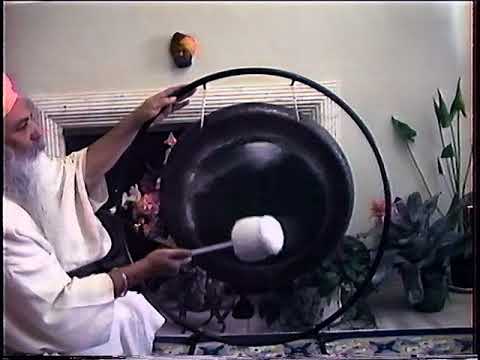
Yogi Bhajan was a master of both yoga and the gong. It took him years to deeply understand its power, and he knew how to use it to accompany a specific meditation, kriya, or asana.
His way of playing was intense, direct, and transformative. He could generate rhythms capable of moving the energy of the room and pushing his students beyond their inner resistance.
He learned to play using gongs used in Indian temples, flat-faced and thicker than many of the gongs used in the West today. For this reason, it’s not advisable to try to literally copy his style.
| Aspect | Yogi Bhajan’s Use of the Gong | Common Use in Today’s Gong Baths |
|---|---|---|
| Main intention | Accompanying kriyas, meditations, and intense processes | Facilitating relaxation, rest, and deep listening |
| Way of playing | More active, direct, and transformative | More enveloping, progressive, and receptive |
| Goal | Helping the student work through resistance | Creating a sound field of integration and calm |
| Context | Kundalini Yoga and Rebirthing classes | Individual sessions, group sessions, or gong baths |
The Tradition of the Gong Master
Within this tradition, playing the gong is not just about producing sound. It requires presence, listening, sensitivity, and an understanding of the effect the instrument can have on the body, mind, and nervous system.
Yogi Bhajan used to say that the most subtle instrument of a yogi is the gong. For him, playing it was an art, not a mechanical technique.
When we watch videos of his classes, or listen to students who learned from him such as Don Conreaux or Mehtab Benton, we understand that his relationship with the gong was not simply about relaxing, but about transforming.
What It Means Today to Train in Gong with Vikrampal
Training in the gong is not about learning an intuitive sequence of strikes. It’s about learning to listen, to hold a space, and to understand how sound can support physical, emotional, and meditative processes.
| Learning Area | What Is Developed |
|---|---|
| Listening | Learning to perceive the sound field and respond with presence |
| Technique | Understanding the use of mallets, intensities, dynamics, and silences |
| Body awareness | Understanding how sound affects the body and nervous system |
| Meditative practice | Using the gong as a tool to enter deep states of attention |
| Facilitation | Holding individual or group sessions responsibly |
How the Gong Should Be Learned Today
Learning the gong requires a solid foundation. Simply having an instrument and playing it intuitively is not enough. Intuition matters, but it must be paired with practice, judgment, and respect for the tradition.
In a serious training program, the student learns to relate to the gong through listening, technique, meditation, and direct experience.
| Stage | What the Student Works On |
|---|---|
| Getting started | First contact with the instrument, posture, listening, and sensitivity |
| Technical practice | Use of mallets, gong zones, rhythms, intensity, and volume control |
| Meditative integration | Understanding the gong within the practice of Sound Therapy and meditation |
| Facilitation | Learning to hold a session without overwhelming the participant |
| Deepening | Developing personal judgment, presence, and maturity as a facilitator |
If you feel this path resonates with you, discover the upcoming gong trainings.
The Gong as a Tool for Transformation
The sound of the gong can create deep relaxation, release the constant flow of thoughts, and stimulate the glandular system.
It facilitates states of spontaneous meditation and allows the experience to unfold without mental effort.
The sensation can feel similar to being wrapped in a cocoon, where body and mind become integrated within the sound field.
For me, the potential of the gong cannot be understood without the practice of Kundalini Yoga.
Who Might a Gong Training Be For?
| Profile | Why It Might Interest Them |
|---|---|
| Kundalini Yoga teachers | To integrate the gong into their classes, meditations, and events |
| Sound therapists | To deepen their use of the gong as a primary tool |
| People on a meditative path | To explore sound as a path to self-knowledge |
| Group facilitators | To learn to hold sound spaces responsibly |
| People who feel called to the gong | To begin a path of practice, listening, and transformation |
Training in the Gong: Taking the Step with Responsibility
If you’re on the path of Kundalini Yoga, or you already work therapeutically with others, the gong can become a profound tool within your practice.
Training with the right approach makes all the difference. It’s not just about playing, but about understanding how and why sound works. Explore the gong sound therapy trainings.
Frequently Asked Questions About the Gong and Training
Do I need prior experience to train in the gong?
Not necessarily. What matters is having a genuine willingness to listen, practice, and learn the instrument with respect. Prior experience in yoga, meditation, or sound can help, but it isn’t always essential.
How long does a gong training last?
It depends on the level and the program. A serious training is usually organized in stages, so the student can progressively integrate technique, listening, and practice.
What certification do I receive?
Certification depends on the specific training and the path chosen. What matters most isn’t just the certificate, but the real experience and judgment the student develops throughout the process.
Can the gong be learned purely by intuition?
No. Intuition matters, but it needs a foundation. The gong requires technique, listening, presence, and responsibility. Playing loudly doesn’t mean playing well.
What is the relationship between the gong and Kundalini Yoga?
In the tradition spread by Yogi Bhajan, the gong holds a central place as a tool for meditation, transformation, and energetic support within the practice.
An Invitation to Begin the Path of the Gong
If you’re training in Kundalini Yoga, if you’re already a teacher, or if you feel a deep calling toward sound, the gong can open a new dimension in your practice.
Look for a training that doesn’t stop at technique alone. Choose a path where you can learn to listen, to hold, and to understand the instrument from within.
Vikrampal Singh

